


RDU Shuttle Luggage: 7 Essential Tips for an Easier Airport Ride

The passenger + luggage planning guide
Make room for the whole trip.
RDU shuttle luggage planning starts with one question: will the confirmed vehicle accommodate every passenger and everything they are bringing? Before booking, provide the passenger count, bag quantities, dimensions of bulky items and any handling needs. Ask the transportation company to confirm the complete load together.
A reservation for four passengers does not automatically describe four passengers with four large suitcases, four rolling carry-ons, a stroller and a golf travel case. Those are different transportation requirements, even though the number of people stays the same.
The easiest time to discover a space problem is before travel day. A clear luggage inventory gives the shuttle company useful information while there is still time to discuss vehicle options and availability.
This guide explains how to count bags, describe unusual items, ask the right questions and prepare for pickup at Raleigh-Durham International Airport. You will also find a booking message you can copy, practical trip examples and a final loading checklist.
How much luggage can you bring on an RDU shuttle?
Luggage capacity depends on the assigned vehicle, seating arrangement, passenger count and the size and shape of the items. Confirm your actual load with the provider. Do not assume that every available passenger seat comes with space for a large suitcase and a rolling carry-on.
My RDU Airport Shuttle’s Sprinter transportation guide asks travelers to disclose luggage and oversized items. A general vehicle description should therefore be followed by confirmation of your particular reservation.
Keep the airline and shuttle questions separate. A bag accepted for your flight still needs to fit the ground transportation arrangement. Likewise, a bag that fits the shuttle may have separate airline size, weight or acceptance requirements.
RDU shuttle luggage: 7 essential planning steps
The goal is to give the provider one accurate description of the trip. Start with the full inventory, add measurements and handling details, and obtain confirmation before treating the arrangement as settled.
01Count every item that will enter the vehicle
Start your RDU shuttle luggage checklist with a complete inventory. Count items according to what will physically travel in the vehicle, rather than counting only the bags you plan to check with the airline.
Commonly overlooked items include backpacks, laptop bags, garment carriers, shopping bags and the stroller that was not included in the original reservation.
For a family or group, ask each traveler to report their luggage individually. Then combine those answers into one list. Avoid replies such as “just a suitcase” or “the usual.” Ask whether that includes a rolling carry-on, backpack or other separate item.
A personal bag may seem too small to mention. Several personal bags can still affect the loading plan, particularly when larger luggage already occupies much of the available cargo space.
A better booking description: “We have four passengers, four large suitcases, three rolling carry-ons and one folded stroller. Can you confirm a vehicle for that complete load?”
For group travel, appoint one person to maintain the final inventory. That person should check the total with each traveler before sending it to the provider. A single agreed list is easier to use than several conflicting messages.
| Item | What to report |
|---|---|
| Large suitcases | Quantity and approximate outside dimensions. |
| Rolling carry-ons | Quantity, including bags passengers expect to keep nearby. |
| Backpacks and personal bags | Quantity and whether any are unusually large. |
| Strollers | Quantity, folded dimensions and any removable parts. |
| Child restraints | Whether installed for use or transported as luggage. |
| Golf travel cases | Quantity, dimensions and whether hard-sided. |
| Sports or work equipment | Type, packed dimensions, approximate weight and stacking limits. |
| Musical instruments | Case dimensions and any specific handling requirements. |
| Mobility equipment | Dimensions, weight, folding details and assistance needs. |
02Measure bulky luggage in its packed condition
Bag labels such as “large,” “oversized” and “full-size” mean different things to different travelers. Measurements are more useful when an item is rigid, unusually long or difficult to stack.
Measure the outside of the packed item, including its protective case, wheels, handles and other protruding parts. Give the dimensions in a consistent order: length, width and height.
State the units. A set of numbers without “inches” or “centimeters” creates an avoidable misunderstanding.
For a stroller, measure it in the folded position it will occupy during transportation. If parts must be removed, explain what comes off and whether those pieces become separate items.
For golf equipment, measure the travel case rather than only the bag inside it. A rigid case can occupy a different shape of space from a soft cover.
- Provide the approximate packed weight.
- Explain whether the item folds or separates.
- Identify anything that must stay upright.
- Say whether other luggage can be placed on it.
- Mention fragile handles or exposed components.
- Explain whether assistance is needed to move it.
A long, narrow case and a short, wide suitcase can have similar overall volume but fit differently through a vehicle opening. The provider needs to assess the shape and loading arrangement, not just the approximate volume.
If you are uncertain how to describe an item, ask whether you can send a photograph alongside its measurements. A photograph can clarify the shape, but it should supplement an accurate description.
03Confirm passengers and luggage together
The most important RDU shuttle luggage question concerns the complete combination of people and belongings. Ask the company to assess the passenger count and cargo inventory together.
A vehicle’s advertised seating capacity does not establish how much cargo space remains in every configuration. Seating layout, installed child restraints and actual luggage dimensions can affect the plan.
Ask this directly: “Does the confirmed arrangement accommodate our passenger count and the full luggage inventory at the same time?”
Do not assume that an unused passenger seat can serve as a storage area for a large suitcase or equipment case. Let the provider determine an appropriate loading arrangement.
Passengers need usable seating, access to their restraints and a clear way to enter and exit. The cargo plan should not depend on someone holding a heavy item throughout the ride.
Ask about vehicle options when your inventory includes several large bags, rigid sports cases, bulky family equipment or substantial work materials. A larger vehicle may be suitable, but its availability and exact configuration still need confirmation.
For broader vehicle information, review the Sprinter van transportation guide. Use this luggage inventory to describe the load your selected arrangement needs to accommodate.
04Flag special items before requesting a final quote
Some items need a more detailed conversation than ordinary suitcases. Mention them when requesting the ride rather than adding them to the loading pile on travel day.
The aim is to confirm whether the provider can accommodate the item and whether it affects the vehicle, handling or price.
Golf clubs and sports equipment
Report the number of travel cases, their packed dimensions and whether they are rigid. Count the regular suitcases and personal bags that accompany the equipment.
For a party traveling toward Pinehurst or Southern Pines, “four golfers” does not describe the full load. Four club cases plus four suitcases require a different assessment from four passengers with small overnight bags.
For other sports equipment, describe the packed object rather than only naming the activity. A compact equipment bag and a long protective case create different requirements.
Strollers and child restraints
Clarify whether a child restraint will be installed for use during the ride or transported as baggage. Those are different arrangements.
Include the folded stroller in the cargo inventory even when it will be gate-checked for the flight. Airline handling does not remove the need to accommodate it in the shuttle.
For restraint-specific questions, use the separate RDU car seat airport shuttle guide. Confirm the actual restraint and vehicle arrangement with the provider.
Mobility equipment
Describe the equipment’s dimensions, approximate weight and folding details. Explain whether the traveler can transfer to a vehicle seat and what assistance is required.
Cargo space alone does not establish that a vehicle is accessible for the person using the equipment. Ask for confirmation of the particular arrangement, including boarding and equipment handling.
Instruments and fragile work cases
Identify anything that cannot have luggage stacked on top of it or that must remain upright. Ask whether the requested handling can be accommodated before treating the booking as complete.
Check airline acceptance requirements separately. Confirmation of ground transportation does not replace the airline’s decision about an unusual item.
05Check charges, loading assistance and change terms
A complete luggage inventory should come before the final pricing conversation. Otherwise, a quote based on a smaller load may not reflect the arrangement you actually need.
Do not assume oversized luggage is automatically included or automatically subject to a surcharge. Ask how your specific request will be handled.
- Does the quote reflect the full passenger and luggage inventory?
- Is a different vehicle required for any of these items?
- Are there additional charges for the confirmed arrangement?
- What loading assistance is available?
- Are there size or weight limits for individual items?
- What happens if the luggage count changes?
- How will a revised vehicle or price be confirmed?
If a traveler cannot lift or move an item, explain that during booking. An object may fit in the cargo area but still require handling that needs advance discussion.
A luggage plan can change between booking and travel day. Someone may add a suitcase, purchase a larger case or decide to bring equipment. Send the revised inventory as soon as you know.
Avoid sending only “We have one more bag.” Identify the additional item and restate the new total so there is one clear version of the plan.
06Prepare for loading before the vehicle arrives
A good RDU shuttle luggage plan includes how the bags will reach the vehicle. At a home, gather the agreed items before pickup. At a hotel, allow time to collect stored luggage and bring the party to the confirmed meeting point.
If equipment must pass through stairs, a narrow doorway or a long corridor, discuss any relevant access needs in advance. Confirm the address and the entrance where passengers will be ready.
Keep your phone, travel documents, keys, wallet and other personal essentials accessible. Avoid placing them inside a large suitcase that will be loaded beneath other belongings.
Use recognizable luggage tags or another simple identifier. Similar black suitcases can be difficult to distinguish when several people travel together.
At loading, verify the number of items. At unloading, count again before the vehicle leaves. Check for small bags, garment carriers and loose accessories that may be easier to overlook.
Show the driver which items are fragile, unusually heavy or restricted from stacking. Let the provider determine how the accepted load should be arranged. Resolve any difference between the confirmed inventory and the actual load before departure.
07Coordinate baggage collection with pickup readiness
An arriving flight and a passenger ready for pickup are different stages of the trip. You may still need to leave the aircraft, reach baggage claim and collect every item.
Follow the provider’s arrival communication instructions. Give an accurate status update rather than saying you are ready while members of the party are still waiting for luggage.
The My RDU Airport Shuttle FAQ advises arriving customers to call 919-728-0195, requests a reachable travel-day phone number and states that the company does not have an airport counter.
Example arrival update: “Our flight has arrived. We are three passengers waiting for two suitcases and one equipment case. We will update you when everyone and all items are together.”
When you are ready, report that clearly and follow the confirmed meeting instructions. Use the airport’s current signs and the provider’s directions. The official RDU transportation page is an additional reference.
If a bag does not arrive, contact the airline and tell the shuttle provider that your readiness has changed. Ask how the situation affects your reservation. Do not assume a later pickup or separate luggage collection trip is included.
For a changed flight itinerary, use the separate RDU flight delays guide to organize the reservation update.
Your visual RDU shuttle luggage checklist
Use this seven-step reminder when preparing the reservation. The practical goal is one confirmed arrangement for the passengers, the bags and any equipment traveling with them.
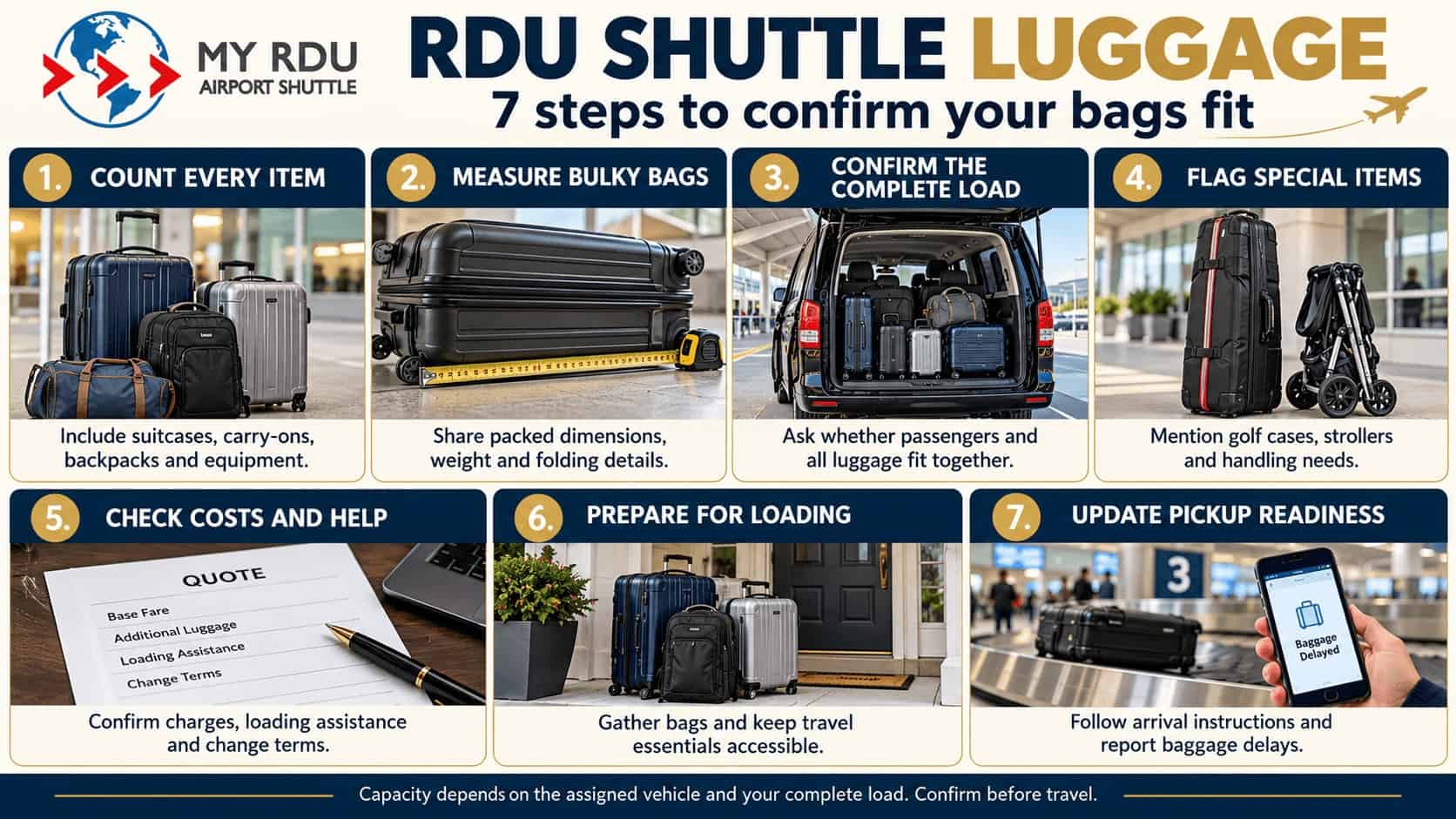
Save the final inventory with your reservation confirmation. If someone else is making the booking, ask the person traveling to verify the list before it is submitted.
Four trip examples: what the provider needs to know
These examples show how to describe a trip. They are illustrative planning scenarios, not vehicle-capacity promises or confirmed quotes.
A family traveling from Cary
Two adults and two children have three suitcases, two backpacks, a folded stroller and child restraints.
The family should clarify the restraint arrangement and provide the stroller’s folded dimensions. Seating and cargo need to be assessed together.
A golf party arriving at RDU
Four travelers have four suitcases, four hard-sided golf travel cases and personal bags.
The organizer should provide the case measurements and the destination address. “Four passengers with clubs” does not fully describe this load.
A business team with event equipment
Three colleagues have three suitcases, three laptop bags and two rigid display cases.
Identify cases that cannot be stacked and provide their dimensions and weight. Confirm the destination entrance and any relevant access arrangements.
A student returning with extra belongings
One traveler initially books with one suitcase, then adds a second suitcase and a large storage container.
The passenger should send the updated inventory before pickup. A small passenger count does not automatically make any amount of luggage acceptable.
For campus addresses and student travel coordination, see the RDU student airport shuttle guide. The luggage decision remains specific to the bags and equipment included in the reservation.
Why the destination still matters
A luggage inventory should be paired with the correct pickup and drop-off details. A hotel name alone may be ambiguous, and a large office or event venue may have several entrances.
Give the full street address and ask which entrance should be used. If the traveler needs assistance beyond ordinary curbside loading, describe the request and obtain confirmation.
The same principle applies whether the trip begins in Raleigh, Durham, Chapel Hill or another location: confirm the route and the complete load rather than assuming that a general service description covers every arrangement.
Copy-and-send luggage confirmation message
Use this template to ask the company to confirm your RDU shuttle luggage arrangement. Replace the bracketed fields with your actual trip details. The template helps you gather information; it does not establish the provider’s policies.
Hello, I would like to confirm vehicle space for our airport trip.
Travel date: [Date]
Direction: [To RDU or from RDU]
Pickup address: [Full address and entrance]
Destination: [Full address and property name]
Passengers: [Total number]
Large suitcases: [Quantity and approximate dimensions]
Rolling carry-ons: [Quantity]
Backpacks and personal bags: [Quantity]
Bulky or special items: [Type, quantity and dimensions]
Handling requirements: [Weight, folding, stacking or assistance details]
Child restraint or mobility arrangements: [Details requiring confirmation]
Travel-day contact: [Name and reachable number]
Return-trip differences: [Additional items or changed passenger count]
Can you confirm that the proposed vehicle accommodates this complete load? Please also confirm any applicable charges, handling limitations and the process if our luggage changes.
If the company requests additional information, update the same inventory. Keeping one complete message is easier than reconstructing the final load from several separate texts.
For someone arranging transportation on another traveler’s behalf, ask the passenger to verify what is actually packed. An organizer’s estimate may miss a carry-on, equipment case or additional suitcase.
The guide to booking an RDU shuttle for someone else explains the separate organizer, passenger and payment questions.
What a useful confirmation should resolve
After the provider replies, check that you understand which inventory was reviewed, whether the passenger-and-luggage combination is accepted, and whether any conditions remain unresolved.
If a response refers only to the passenger count, ask about the luggage list explicitly. If you added a special item later, make sure the latest confirmation includes that change.
Keep the confirmation available to the person present at pickup. That person should be able to explain the arrangement without needing to reach an unavailable organizer.
Plan the return luggage separately
The return journey may involve a different load. Travelers sometimes come home with purchases, gifts, additional equipment or belongings collected during the trip.
Review the outbound and return inventories separately. Do not assume that a roundtrip reservation automatically accommodates any additional items brought back.
If the difference is already known, disclose it during booking. If it becomes clear later, contact the company with the revised return inventory and ask for confirmation.
Practical example: “Our outbound trip has two passengers and two suitcases. On the return, we expect three suitcases and one rigid equipment case. Can you review each direction separately?”
Also check whether the return party has the same number of passengers. A person joining the trip later changes both the seating requirement and the potential luggage load.
For an airport arrival, make sure the travel-day contact has the updated inventory and pickup instructions. A correct reservation is most useful when the person meeting the driver understands it.
Recheck after your final packing session
Do a final count once the bags are actually packed. An estimated inventory can change when a suitcase proves too small or a fragile item needs a separate protective case.
If the final load differs from what was confirmed, report the change before pickup. Do not rely on compressing, stacking or rearranging items in a way the provider has not assessed.
This last review is particularly useful for group trips, where several people may pack independently and assume that someone else has reported their additions.
Common luggage-planning mistakes to avoid
Counting only checked bags
Rolling carry-ons, backpacks, strollers and equipment still travel in the vehicle. Include them even when the airline treats them as a different baggage category.
Assuming a larger vehicle has unlimited space
Every vehicle has a particular layout. Confirm the full load rather than relying on the vehicle category or advertised passenger capacity alone.
Leaving protective cases out of measurements
A golf bag, instrument or piece of equipment can become larger once packed for travel. Measure the form that will actually be transported.
Treating a booking note as acceptance
A note communicates a request. Follow up until the relevant vehicle, equipment or handling arrangement has been confirmed.
Forgetting the return journey
Purchases and extra belongings can change the return load. Review both directions and communicate additions before the return pickup.
Waiting until pickup to mention assistance
Describe lifting or handling needs in advance. Whether something fits and whether the requested assistance is available are separate questions.
Avoiding these mistakes does not require a complicated document. A short, complete inventory and a clear confirmation are usually more useful than a long message filled with estimates.
Frequently asked questions about RDU shuttle luggage
Is there a standard suitcase allowance for every RDU shuttle?
Do not assume a universal allowance. Ask the provider to confirm the number and dimensions of bags for the assigned vehicle and passenger count. General seating capacity is not a complete luggage specification.
Do carry-ons count as shuttle luggage?
Yes, include them in the inventory you submit. An airline’s carry-on category describes how an item travels on the aircraft. It does not remove the space that item occupies in the ground transportation vehicle.
Can I bring golf clubs on an RDU shuttle?
Ask the company to confirm your packed golf travel case. Provide its dimensions, whether it is hard-sided and the rest of the party’s luggage. Acceptance and vehicle selection should be confirmed for the actual reservation.
Should I measure an ordinary suitcase?
Measurements are especially helpful for very large, rigid or unusual items. If you are uncertain whether a suitcase is standard-sized, provide its approximate outside dimensions, including wheels and handles.
Can two passengers need a larger vehicle because of luggage?
Yes, a small party can have substantial cargo. Two people with several large suitcases and rigid equipment cases may need a different arrangement from two people with backpacks. Ask the provider to assess the complete load.
Is loading assistance automatically included?
Confirm the assistance available for your trip, particularly for heavy, fragile or awkward equipment. Explain the approximate weight and any access issues. General luggage support should not be assumed to cover every lifting or handling request.
Can I add another suitcase after booking?
Contact the company with the revised total and ask whether the existing arrangement still works. Vehicle requirements, availability or pricing may need review. Obtain confirmation rather than arriving with an unreported addition.
Does a shared ride have the same luggage arrangement as a private ride?
Do not assume so. Ask how your inventory will be accommodated under the specific service booked. The provider must assess it within the actual arrangement, including any other passengers or cargo assigned to the vehicle.
What if baggage claim takes longer than expected?
Follow the provider’s arrival instructions and communicate the delay. Explain what you are still waiting for and ask how to coordinate pickup. Avoid promising a readiness time you cannot reasonably estimate.
Does a roundtrip booking cover additional return bags?
Confirm luggage for each direction. If you expect to return with more items, disclose that during booking. If plans change later, send an updated inventory and ask the company to confirm the return arrangement.
What if my equipment does not fold?
Say so explicitly and provide its full packed dimensions. Do not describe the item as compact unless that reflects its actual transportation condition. Ask whether the assigned vehicle can accommodate the rigid shape.
Should the passenger or organizer confirm the luggage?
The person packing should verify the inventory. An organizer can submit it, but the passenger should check the final count and receive the confirmed arrangement. That helps prevent differences between the booking details and the items brought to pickup.
Your final travel-day checklist
Before the trip, review the confirmed inventory with everyone traveling. The person meeting the vehicle should know the total item count and any handling instructions already discussed.
- We have counted every passenger and every separate item.
- We included carry-ons, personal bags and family equipment.
- We measured bulky items in their packed or folded condition.
- We disclosed fragile, heavy and non-stackable items.
- The provider confirmed the passenger-and-luggage combination.
- We clarified any charges and assistance requirements.
- The traveler has the pickup instructions and contact number.
- We reviewed the luggage separately for the return journey.
- We will report any changes to the confirmed inventory.
- Someone will count the items at both loading and unloading.
Keep travel essentials accessible and avoid last-minute additions without notifying the company. If a detail is unclear, resolve it before pickup rather than relying on an assumption.
For more airport planning resources, browse the My RDU Airport Shuttle travel tips.
Confirm the complete load
A clearer luggage plan starts with the right details.
The most useful RDU shuttle luggage plan is specific: an accurate passenger count, a complete bag inventory, measurements for unusual items and confirmation from the company.
Gather those details before booking. Contact My RDU Airport Shuttle to discuss vehicle space, handling needs and the arrangement for your trip.
Want to find more articles from RDU Airport Shuttle in Google Search? Add this site to your Preferred Sources.


