


Higher Gas Prices, Busy Travel Days, and the Real Cost of Getting to RDU Airport in 2026
Gas prices are back in the travel conversation, and that matters more for airport travelers than many people realize. As of March 30, 2026, AAA listed the national average for regular gasoline at $3.99 per gallon and North Carolina’s average at $3.759 per gallon. AAA also reported that the national average had jumped roughly one dollar in a month, a sharp shift that changes how travelers budget for road trips, weekend getaways, and even simple airport drop-offs.
For travelers flying out of Raleigh-Durham International Airport, fuel prices are only part of the story. Once gas prices rise, people start noticing every other transportation cost more clearly: parking, traffic delays, extra buffer time, curbside rules, and the possibility of missing a preferred lot or getting stuck in a longer-than-expected preflight routine. RDU itself advises passengers to arrive at least two hours before domestic flights and three hours before international flights, with extra time during peak periods, holidays, and busy morning or evening travel windows.
That combination is exactly why My RDU Airport Shuttle feels a timely blog topic built around gas prices works so well right now. Searchers are not just asking, “What are gas prices?” They are really asking a more practical question: What is the smartest, least stressful, and most cost-effective way to get to the airport now that travel costs feel less predictable again? That is where this topic becomes commercially relevant and citation-worthy.
Why rising gas prices matter for airport travelers
When gas prices move up, travelers stop treating the drive to the airport as a minor expense. They start looking at the full chain of costs: fuel burned on the way there and back, airport parking rates, extra time needed to park and transfer, and the stress of building enough cushion into the trip. That is where planning travel through RDU becomes more important than most people expect.
A lot of travelers only compare the visible number on a parking lot sign to the price of a ride. That is not the best comparison. The smarter comparison is this:
- What will the entire airport run cost?
- How much time does each option require?
- What happens if there is traffic, parking congestion, or a late-night arrival?
- Which option gives you the most predictable experience?
Those are the questions that push many travelers toward prearranged transportation and encourage them to book your airport ride online rather than improvising on the day of departure.
Why gas prices are suddenly part of airport planning again
The reason this topic has traction is simple: price spikes change behavior. AAA’s March 2026 reporting shows a rapid spring increase in gas prices, while its North Carolina average also moved up noticeably through the month. At the same time, AAA connected the increases to crude-oil pressure and seasonal demand.
There is also an important nuance here that makes the topic stronger, not weaker. Earlier EIA forecasts indicated that the annual U.S. average gasoline price in 2026 could be lower overall than 2025, but short-term spikes still happen, and those spikes are what travelers feel in real time when they start planning airport transportation. In other words, a lower annual forecast does not help much when you are paying more this week, parking for several days, and trying to get to an early-morning flight.
That distinction is exactly the kind of context that helps a blog earn trust. It avoids oversimplifying the news. It tells readers that yes, broader energy forecasts matter, but immediate travel decisions are usually driven by what is happening right now at the pump, on the road, and at the airport.
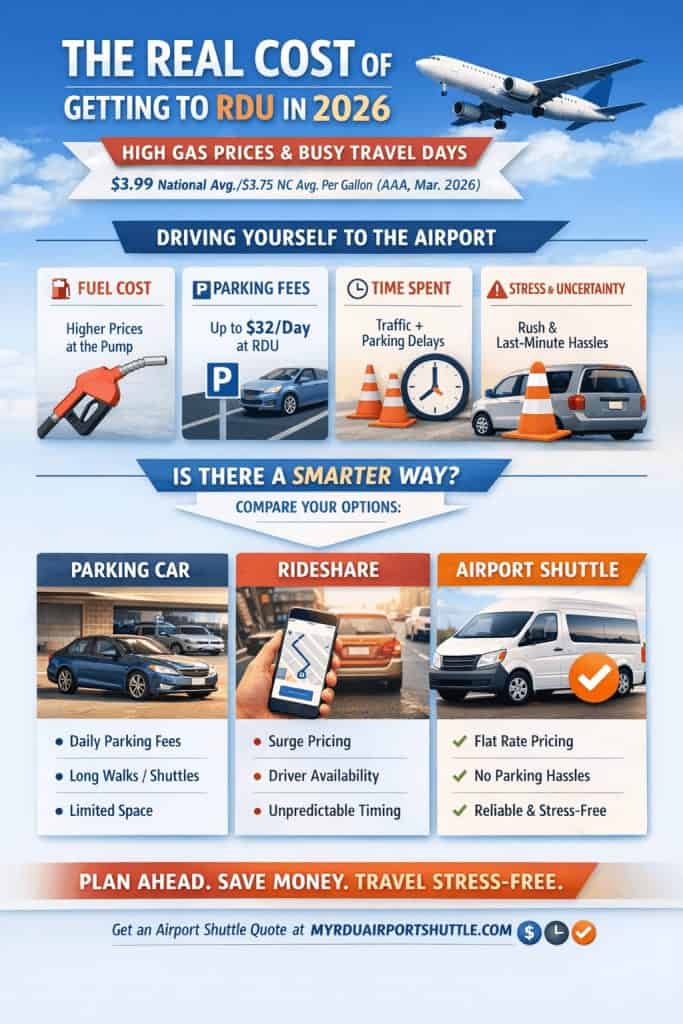
What rising fuel costs actually change for RDU travelers
When fuel gets more expensive, travelers tend to assume the only real consequence is a higher fill-up bill. In practice, airport transportation decisions become more sensitive in four areas:
1. Driving yourself feels more expensive
A trip to the airport is never just a one-line cost. It includes the drive there, the drive home, wear on your vehicle, and the chance that you circle, reroute, or idle longer than expected if traffic or terminal access is busy. When fuel jumps, those “small” costs stop feeling invisible. AAA’s March pricing data makes that especially relevant right now.
2. Parking decisions matter more
RDU’s official parking options are convenient, but they are not interchangeable. Current posted drive-up rates list Premier at $32 daily, Central at $21 daily, and Express at $17 daily. Economy is the lowest-cost on-airport option, with a $3 hourly rate up to four hours on day of entry and daily rates thereafter, and RDU notes that Economy 4 is no longer accepting airport guests. That means the real cost of self-driving can escalate quickly depending on length of trip and lot choice.
3. Time buffers get larger
RDU recommends arriving early for good reason. The airport advises two hours for domestic departures and three for international departures, while also noting that security wait times vary and that most passengers move through screening in under 30 minutes, though peak periods can be longer. Both terminals’ security checkpoints open at 4 a.m. These details matter because self-parking adds tasks: finding the right lot, parking, unloading bags, transferring to a shuttle if applicable, reaching the terminal, checking bags, and clearing security.
4. Travel feels busier overall
RDU has publicly stated that it is experiencing record demand and continued passenger growth, with forecasts approaching more than 16 million passengers annually. That does not mean every day is chaotic, but it does reinforce the idea that airport planning is less forgiving when demand is strong. A transportation choice that removes variables can have real value, especially for early departures, family travel, or longer trips.
The hidden cost of driving yourself to the airport
One of the strongest angles for this blog is helping readers think beyond sticker-price comparisons. Many travelers compare only “parking rate versus shuttle quote,” which is too narrow. The better comparison is total travel-day cost.
Fuel
Gasoline is the obvious line item. If fuel prices rise sharply in a short period, each airport run becomes more expensive than the same trip felt a month earlier. Even if the raw dollar difference does not seem dramatic for one tank, the perception shift changes behavior. People become less willing to absorb waste, detours, or redundant driving.
Parking
Parking is often the largest direct cost of driving yourself. A four-day trip at Premier rates is materially different from a four-day trip at Express or Economy pricing. Travelers who book late may also lose the psychological benefit of feeling organized, because RDU encourages online booking in advance and notes that guests should book parking at least 24 hours ahead.
Time
Time is not abstract on a travel day. Time is the difference between leaving calmly and leaving in a hurry. It is the gap between a smooth curb-to-checkpoint experience and an anxious one. Every additional step introduces friction: driving, parking, unloading, walking or shuttling, and navigating the terminal with bags or children.
Stress and uncertainty
This is the cost category most blogs ignore, which is exactly why including it improves citation potential. At RDU, terminal curbs are for active loading and unloading only, and checkpoint timing can vary by demand and time of day. That means travelers who are trying to improvise their arrival strategy on the day of travel can end up creating their own stress. Prearranged transportation can reduce those decision points.
Why prearranged airport transportation can make more sense than travelers expect
This is where the article should naturally support conversion without sounding sales-heavy.
For many trips, the real value of a shuttle or private airport transportation service is not that it is always the absolute cheapest option in every scenario. The value is that it can be the most predictable option. In a year when gas prices have become more volatile again, predictability matters more.
A prearranged ride can remove or reduce several cost variables at once:
- no airport parking decision
- no need to compare lot pricing on the fly
- no walking from a distant lot or waiting on a parking shuttle
- no last-minute worry about curbside rules or terminal timing
- less dependence on spot-market rideshare pricing
- clearer departure planning for groups, families, and early flights
RDU’s own ground transportation guidance makes it clear that prearranged transportation operates at the airport and has designated pickup zones outside bag claim in each terminal. That structure matters because travelers are not dealing with an improvised pickup process after a long flight.
For airport shuttle companies, this is the practical message to reinforce: the most affordable option is not always the lowest visible line item; it is often the option with the fewest hidden costs.
When driving yourself still makes sense
A people-first blog should acknowledge reality. Driving yourself can still make sense in some cases:
- you live very close to RDU
- your trip is short enough that parking costs stay low
- you already prefer a specific lot and know the airport well
- your flight time and party size make self-driving more practical
- you have a strong discount or loyalty reason to choose on-airport parking
That transparency helps build trust. It shows the page is not trying to force one answer for every traveler. Instead, it is helping readers decide based on trip length, total cost, and complexity.
How early to leave for RDU when traffic, parking, and bag drop are factors
This section is especially valuable because it aligns with one of the most common airport intent queries.
RDU says travelers should arrive two hours before domestic flights and three hours before international flights, while also allowing extra time during peak periods, holidays, and busy morning or evening windows. The airport also notes that most airlines begin boarding 30 to 45 minutes before departure, which means travelers who plan around departure time rather than boarding time can accidentally compress their margin.
For travelers driving themselves, a realistic preflight timeline often includes:
- drive time to the airport
- parking or lot entry time
- unloading and moving luggage
- shuttle transfer time if using a remote lot
- airline bag-drop timing
- checkpoint time
- walking time to the gate
For travelers using prearranged airport transportation, some of those variables shrink. That does not eliminate the need to leave early, but it can make the timing easier to manage.
There is also one more travel-day detail worth mentioning in 2026: ID compliance. TSA and DHS have already moved into REAL ID enforcement, and TSA also announced a paid alternative identity-verification option for travelers without acceptable ID who still want to fly. That is not something travelers should plan to rely on, because any ID issue can slow the airport process. A smarter approach is to verify identification before travel and avoid creating extra uncertainty on departure day.
A simple framework for choosing between parking, rideshare, and a shuttle
Choose parking if:
Parking usually makes the most sense when your trip is short, your drive to RDU is easy, and you are comfortable handling the airport process yourself. It is often best for travelers who value control over convenience and do not mind managing the full sequence from driveway to gate.
Choose rideshare if:
Rideshare may make sense when your timing is flexible and the rate is acceptable at booking time. The challenge is unpredictability. Dynamic pricing and driver availability can change quickly, especially during peak travel windows.
Choose a prearranged shuttle or airport transportation service if:
A shuttle or prearranged airport ride tends to make the most sense when you want a known plan, a lower-friction departure experience, fewer parking variables, and a clearer total-trip calculation. It is particularly useful for families, longer trips, business travelers, early departures, and anyone who wants to reduce airport-day decision fatigue.
The smartest way to reduce travel-day friction in 2026
The best travel advice is usually not dramatic. It is procedural.
If fuel prices remain elevated or volatile, travelers should stop evaluating airport transportation as a last-minute errand and start treating it like part of the flight booking itself. That means comparing:
- round-trip driving cost
- parking duration
- terminal timing
- peak travel periods
- party size
- baggage complexity
- pickup reliability after arrival
RDU’s latest travel guidance reinforces the value of planning ahead, from arrival timing to checkpoint preparation to parking reservations. With the airport handling continued growth and travelers facing higher transportation sensitivity than they did earlier in the year, the smartest move is often the one that removes the most uncertainty before the trip starts.
For this blog’s core thesis, that is the takeaway: gas prices may be the news hook, but the real traveler issue is total airport-trip efficiency. When travelers look at the full picture instead of a single cost line, prearranged transportation becomes much easier to justify.
FAQs
Gas prices are influencing airport travel decisions because travelers are paying closer attention to the full cost of getting to the airport, not just the cost of the flight. AAA reported that the national average for regular gasoline reached about $3.99 on March 30, 2026, while North Carolina’s average was about $3.759. When fuel increases that quickly, travelers become more likely to compare self-driving, parking, rideshare, and prearranged transportation instead of defaulting to driving themselves. The result is a broader focus on total cost, convenience, and predictability.
It depends on trip length, fuel cost, lot selection, and how many people are traveling. RDU’s current posted drive-up rates include Premier at $32 per day, Central at $21 per day, and Express at $17 per day, with Economy as the lower-cost on-airport option. Once you add gasoline, vehicle use, parking time, shuttle transfers from remote lots, and the value of your time, prearranged airport transportation can be more competitive than many travelers assume, especially for longer trips or early departures. The most accurate comparison is a full-trip comparison, not a single-line parking rate comparison.
RDU advises travelers to arrive at least two hours before domestic flights and three hours before international flights, with extra time during busy travel periods. If you are parking your own car, you should account for more than just the drive to the airport. You may need time to enter the lot, find a space, unload bags, board a parking shuttle if applicable, reach the terminal, check bags, and pass through security. Both terminals’ security checkpoints open at 4 a.m., and most passengers move through screening in under 30 minutes, though that can increase at peak times.
More travelers are comparing these options because cost volatility makes hidden travel expenses more noticeable. When gas prices rise, parking fees feel larger, and travelers become less willing to absorb extra friction on departure day. At the same time, RDU is experiencing continued passenger growth, which reinforces the value of planning ahead. A shuttle or prearranged ride is attractive because it can remove several uncertainty points at once, including parking availability concerns, remote-lot transfers, and last-minute terminal timing stress.
Yes. RDU advises guests to book parking online in advance and specifically notes that travelers should book parking at least 24 hours ahead using its online booking system. Booking ahead can save time and reduce uncertainty, especially during busier travel periods. Even so, travelers should still compare the full cost of self-driving versus booking transportation, particularly if the trip is several days long or requires a more complex departure schedule.
Yes. RDU’s official ground transportation guidance confirms that prearranged transportation services operate at the airport, and the airport provides designated pickup zones for prearranged service outside baggage claim in each terminal. That matters for arriving passengers because it creates a more organized handoff point than an improvised pickup arrangement. For travelers who prioritize a smoother airport arrival or departure process, that structure can be a significant advantage.
Gas prices are only one part of the airport transportation decision. Travelers should also consider parking rates, time needed for check-in and security, terminal boarding timelines, baggage handling, ID readiness, traffic conditions, and how much uncertainty they want on travel day. RDU notes that airlines often begin boarding 30 to 45 minutes before departure, and TSA identification compliance remains important because ID problems can slow the process. The most useful planning approach is to evaluate the full chain of travel-day tasks instead of focusing on one expense in isolation.
The smartest way is to compare total trip cost, not just the most visible charge. Start with fuel and parking, then add time, stress, lot transfer logistics, and the risk of delays. If you are taking a longer trip, traveling with family, flying early, or leaving during a peak period, prearranged airport transportation may offer better overall value because it reduces both direct costs and friction costs. Travelers who want the lowest-risk airport day often benefit from making transportation part of the trip plan early rather than treating it as a last-minute errand. This is especially true while gas prices remain elevated relative to earlier in 2026.


