

Traveling Through RDU With Accessibility Needs
Traveling Through RDU With Accessibility Needs: RDU accessibility Guide
Planning RDU accessibility needs works best when each request goes to the right place before travel day: the airline, RDU, TSA Cares, and your pre-booked transportation provider. A private airport ride can help coordinate door-to-terminal timing and pickup details, but it does not replace airline wheelchair service, TSA screening assistance, RDU airport assistance, or medical transportation. If you are traveling with mobility equipment, a hidden disability, an older passenger, a caregiver, or extra luggage, write down the details early and confirm what each organization can and cannot do.
Quick Answer
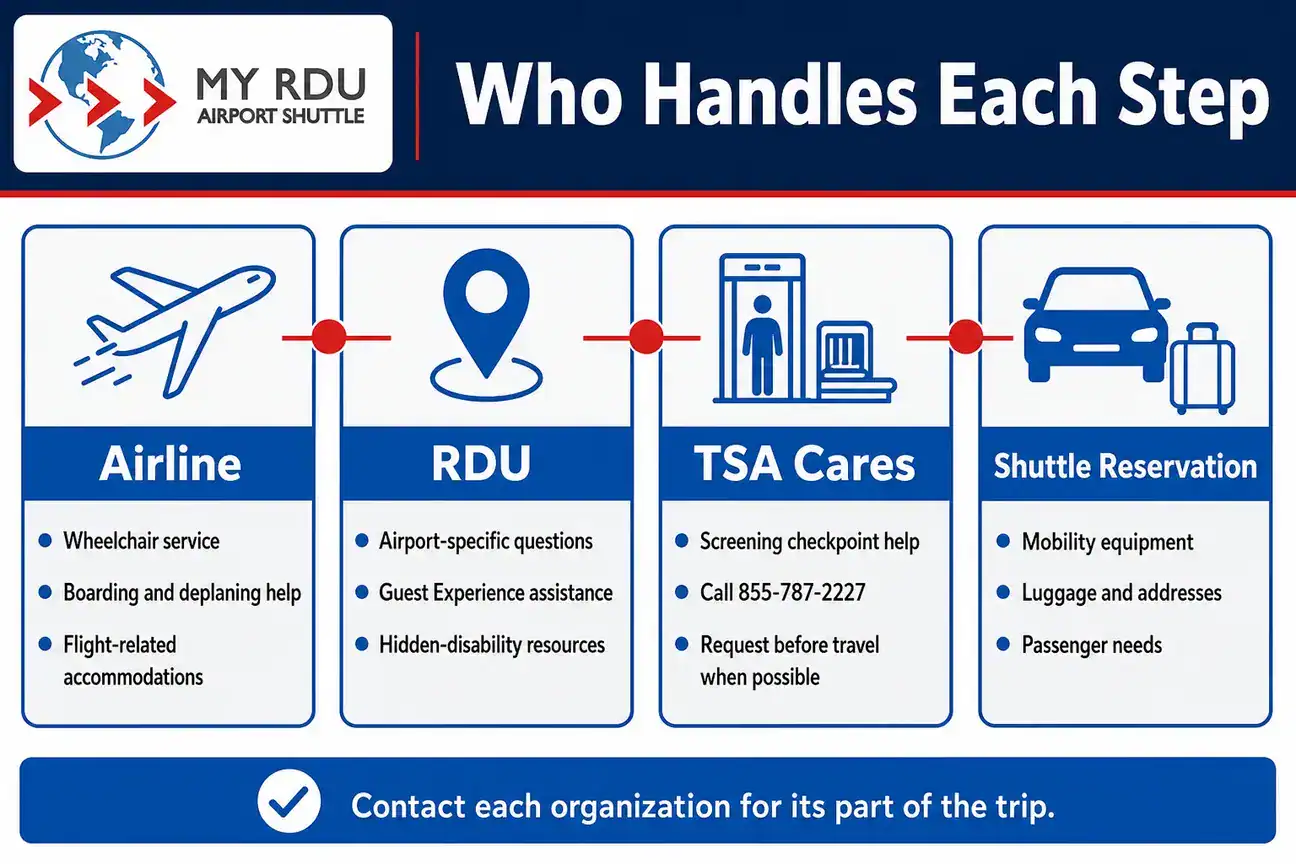
Ask your airline for wheelchair service, boarding help, deplaning help, and flight-related disability accommodations. Contact RDU for airport-specific questions, Guest Experience assistance, and hidden-disability resources. Contact TSA Cares for help related to the security-screening checkpoint. Tell My RDU Airport Shuttle about mobility equipment, luggage, addresses, passenger needs, and any vehicle requirements before booking, then confirm what can be accommodated.
RDU accessibility starts with separate plans
Many stressful airport days happen because one request is assumed to cover everything. It usually does not. A wheelchair request with an airline, for example, does not automatically tell a private transportation company how much luggage or equipment space is needed. A TSA Cares request does not arrange curb-to-aircraft wheelchair assistance. A ride reservation does not create an airport escort inside the terminal.
For travelers using RDU airport taxi service from My RDU Airport Shuttle, the transportation plan is the door-to-terminal or terminal-to-door portion of the trip. That plan should include the ride time, pickup location, flight number, passenger count, bags, mobility equipment, and a travel-day phone number. Accessibility questions that belong to the airline, RDU, or TSA should still be handled directly with those organizations.
The easiest way to stay organized is to divide the trip into four buckets:
- Airline: wheelchair service, boarding, deplaning, in-flight assistance, and flight-related disability accommodations.
- RDU: airport information, Guest Experience help, wayfinding, hidden-disability resources, and airport-specific questions.
- TSA Cares: security-screening assistance and screening-process questions.
- My RDU Airport Shuttle: pre-booked ride details, pickup address, luggage, mobility equipment, passenger count, timing, and what the vehicle arrangement can accommodate.
This article focuses on practical coordination, not promises. Vehicle fit, equipment handling, timing, and availability should be confirmed directly before travel. My RDU Airport Shuttle should not be used as medical transportation, in-terminal escort service, or a replacement for airline or airport assistance.
How wheelchair assistance RDU requests work with the airline
If the traveler needs wheelchair service connected with the flight, start with the airline. RDU states that wheelchair assistance is provided by the airline and should be requested when booking or before travel. That includes help commonly associated with moving through the airport for a flight, boarding, deplaning, and related airline accommodations.
Use the phrase wheelchair assistance RDU as a planning reminder, but do not stop at the airport name. The important action is contacting the airline that operates the flight. If the traveler has a connection, ask the airline how wheelchair assistance will work at each airport, not only at RDU.
For a departing flight, the airline should know whether the traveler can walk short distances, stand during boarding, transfer to an aircraft seat, or needs help from curb or check-in through the terminal. For an arriving flight, the airline should know whether assistance is needed from the aircraft to baggage claim or another airport location. My RDU Airport Shuttle can coordinate the outside transportation portion only after the ride details are confirmed.
Caregivers should keep airline confirmation details separate from the shuttle reservation. A note that says “wheelchair requested” on the flight itinerary is helpful, but it does not tell the ride provider whether the traveler has a folding wheelchair, a power chair, a scooter, a walker, a cane, or several pieces of luggage.
When discussing wheelchair assistance RDU needs, ask the airline direct questions:
- Where should the traveler go on departure day to receive airline wheelchair service?
- What information should be added to the reservation record?
- How will assistance work if the flight arrives late or the gate changes?
- Where will assistance end after arrival at RDU?
- Who should a caregiver contact if the traveler needs help before reaching baggage claim?
The airline and the transportation provider are separate organizations. That separation matters most when the traveler arrives at RDU and needs to move from the aircraft to baggage claim and then to the commercial pickup zone. Confirm each step so no one assumes another organization is responsible.
A clear airline assistance plan should also include the traveler’s own mobility details. Airline staff may need different information than a shuttle reservation team. Keep both plans written down so the caregiver, traveler, airline, and transportation provider are working from the same basic facts.
TSA Cares RDU planning for the screening checkpoint
TSA Cares RDU planning is about the security checkpoint, not the whole airport journey. TSA says TSA Cares assistance is only available through the screening checkpoint and that travelers needing in-flight or curb-to-aircraft wheelchair assistance should contact the airline. That distinction is important for travelers with mobility devices, medical conditions, sensory needs, cognitive disabilities, or other special circumstances.
RDU’s special-assistance information says travelers can contact TSA Cares at 855-787-2227 at least 72 hours before the flight to request assistance. TSA’s request page also says that if a flight is within 72 hours, travelers should call TSA Cares at that number. If you are close to travel day, call rather than assuming an online request will be handled in time.
Use TSA Cares RDU as a checklist item when preparing a departure from RDU. It may be helpful when the traveler needs additional communication, has a medical device, travels with medically necessary items, has a hidden disability, or wants to understand what to expect during screening. TSA Cares does not arrange a private ride, carry luggage to a vehicle, provide airline boarding help, or manage post-landing pickup.
Before contacting TSA Cares, write down the traveler’s name, flight date, airline, flight number, airport, general screening concern, and the best contact information. Avoid waiting until the morning of the flight if the need is already known. Screening lines, airline schedules, traffic, weather, and individual assistance needs can all affect how the day feels.
If a caregiver is booking the ride and someone else is traveling, share the TSA Cares plan with the traveler in plain language. A short written note can help: “Airline handles wheelchair service. TSA Cares is for screening. My RDU handles the pre-booked ride. Call after landing.” That simple division can prevent confusion when several people are helping.
A checkpoint assistance request should be treated as one part of the departure timeline. It may affect how early the traveler wants to arrive at the checkpoint, but it does not replace the airline’s arrival guidance, the ride pickup window, or the traveler’s need for a calm pace.
What RDU can help with at the airport
RDU is the right contact for airport-specific assistance questions, Guest Experience information, wayfinding, and hidden-disability resources. The airport’s special-assistance page lists RDU Guest Experience at 919-840-2123 for help before, during, or after a trip. It also describes resources such as the Hidden Disabilities Sunflower Program and directs travelers to contact airlines for airline accommodations.
RDU is especially important when a traveler or caregiver needs to understand the airport layout, terminal information, or how to request airport-specific arrangements. Terminal 1 serves Southwest, while Terminal 2 serves other airlines. Current airport signs and the traveler’s airline information should guide the final path on travel day.
The RDU airport plan should not be confused with the private ride plan. Airport staff and airport programs may help with airport navigation or information, but My RDU Airport Shuttle has no airport counter and does not provide in-terminal meet-and-greet service. The arriving passenger still needs to call 919-728-0195 after landing and follow the reservation confirmation and current airport signs.
When caregivers are involved, decide in advance who will contact RDU if airport questions come up. It may be the traveler, a family member, a travel coordinator, or the person who booked the ride. The key is to avoid leaving airport questions until the traveler is already tired, separated from a caregiver, or trying to manage luggage and equipment at the same time.
Hidden disabilities RDU resources and practical communication
hidden disabilities RDU planning should focus on practical needs, not only diagnosis labels. RDU participates in the Hidden Disabilities Sunflower Program, which allows travelers to discreetly indicate that they may need additional assistance, understanding, or time while navigating the airport. A sunflower lanyard, pin, or other indicator can support communication, but it does not replace direct requests to the airline, RDU, TSA Cares, or a transportation provider.
For travelers with autism, dementia, anxiety, hearing differences, low vision, chronic illness, brain injury, or other non-obvious needs, a written plan can help. The plan does not need to share private medical details. It should explain what helps the traveler move through the day safely and calmly.
Useful hidden disabilities RDU notes might include:
- “Please give step-by-step pickup instructions.”
- “Traveler may need extra time to process directions.”
- “Caregiver will speak by phone after landing.”
- “Traveler is sensitive to noise and crowded spaces.”
- “Traveler should not be rushed while collecting bags.”
- “Use the travel-day phone number first, then the backup contact.”
Share only the information that is needed for the organization receiving it. The airline may need flight-related accessibility information. TSA Cares may need screening-related information. RDU may need airport-assistance information. My RDU Airport Shuttle needs ride logistics: where to pick up, where to drop off, how to communicate, what equipment and bags are traveling, and what must be confirmed before the ride.
For non-obvious accessibility needs, communication can be more useful than a long medical explanation. A caregiver might say that the traveler needs short instructions, time to move away from a crowded area, or a backup phone contact. Those practical details can be shared without disclosing more personal information than necessary.
Older passengers often benefit from the same approach. A caregiver can book the ride, but the traveler should still have the company phone number, airline information, and a simple instruction card if they are comfortable using one. For more detailed senior travel planning, the RDU airport shuttle for seniors guide can help families think through communication and reservation details.
Accessible airport transportation details to share before booking
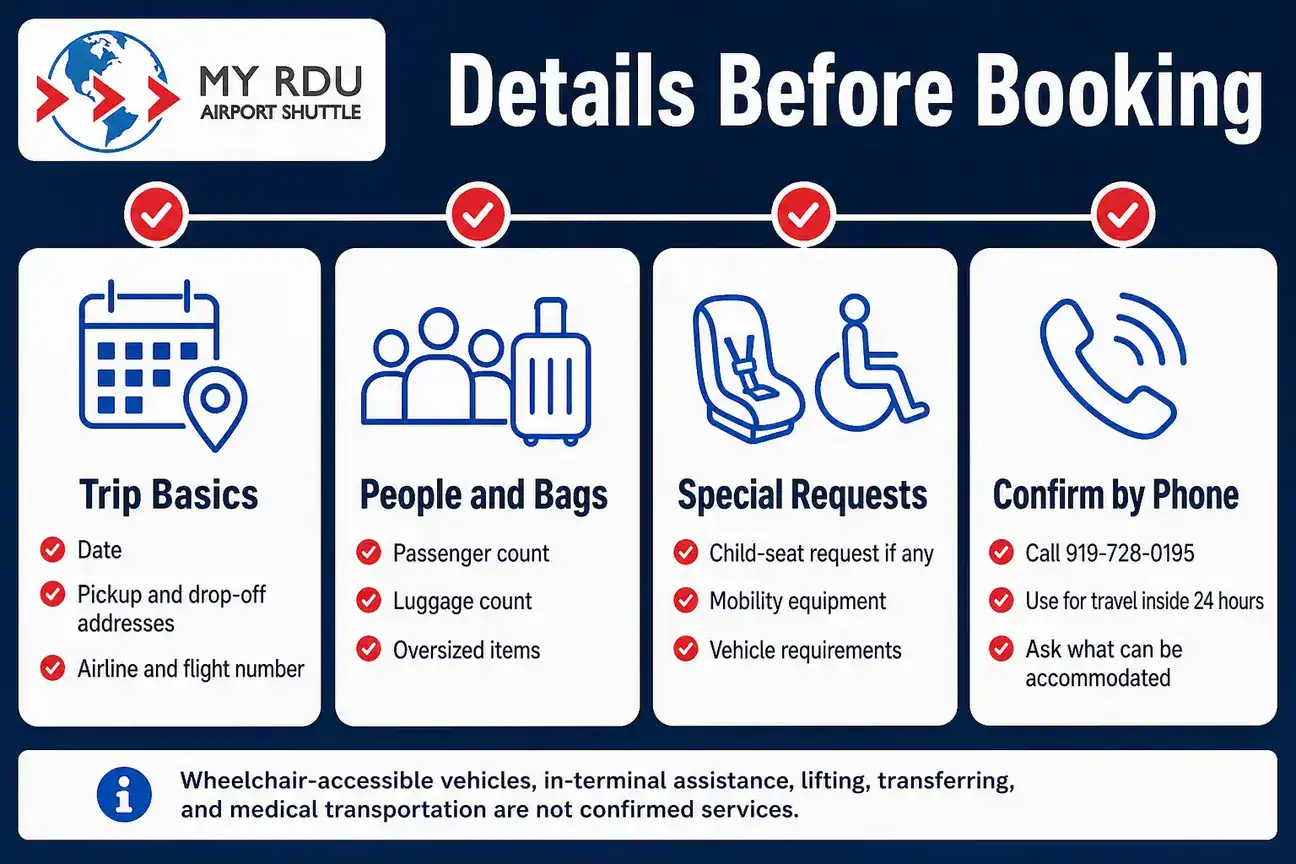
accessible airport transportation planning with My RDU Airport Shuttle should happen before the reservation is finalized, not at the curb. The company offers reservation-based, flat-rate airport rides with no surge pricing, but wheelchair-accessible vehicles, in-terminal assistance, physical lifting, transferring, and medical transportation are not confirmed services. Ask direct questions and confirm what can be accommodated.
When you book your ride online, include the airline and flight number, date, pickup and drop-off addresses, passengers, luggage count, child-seat request if any, and a travel-day phone number. If travel is inside 24 hours, call 919-728-0195 to check availability rather than assuming an online reservation can be accepted.
For accessible airport transportation, do not rely only on an “Accessible” checkbox or a short note. Use plain details that help the reservations team understand the trip. If a caregiver is booking, include both the traveler’s name and the caregiver’s phone number. If a hotel, campus, residence, or office has a specific entrance that works better for mobility needs, write that down too.
| Detail to provide | Why it matters |
|---|---|
| Airline and flight number | Helps identify the trip and likely terminal information. |
| Pickup and destination address | Establishes the actual door-to-terminal or terminal-to-door ride. |
| Passenger count | Helps the company discuss vehicle needs and space. |
| Bags and oversized items | Luggage, sports gear, and equipment can affect available room. |
| Mobility device type | Wheelchairs, scooters, walkers, and canes have different space needs. |
| Approximate equipment dimensions | Folded or travel dimensions help the company discuss fit. |
| Transfer ability | Clarifies whether the traveler can transfer into a vehicle seat. |
| Child-seat request, if any | Allows the request to be recorded and confirmed. |
| Travel-day phone number | Supports communication after landing or if plans change. |
| Backup caregiver contact | Gives the company another person to reach if coordination is needed. |
When discussing the ride, ask what is confirmed and what is not. For example: “Can this vehicle arrangement fit one traveler, one folding walker, one checked bag, and one carry-on?” is more useful than “We need accessibility.” If the traveler uses a power wheelchair or scooter, ask whether it can be accommodated before booking. Share approximate dimensions and travel configuration when available.
My RDU Airport Shuttle also provides broader airport shuttle services and point-to-point transportation, but the exact accessibility-related arrangement must be confirmed for the specific ride. Do not assume one successful past trip means the same vehicle, space, timing, or assistance will be available on another date.
Good accessible airport transportation notes are specific enough to answer space and timing questions. Instead of writing only “accessibility help,” describe the device, bags, transfer needs, communication needs, pickup entrance, and who should be called on travel day.
Mobility equipment, luggage, and space should be discussed together
A mobility device is not the same as luggage, but it still affects the ride plan. A folding wheelchair, walker, cane, scooter, oxygen-related item, or other device may take up space that would otherwise hold bags. Tell the company about equipment and luggage separately so the full space picture is clear.
Ask specific questions before travel day:
- Does the equipment need to fold for the ride?
- Can the device remain assembled, or should it be prepared for transport?
- Can the traveler transfer into a vehicle seat?
- How many checked bags, carry-ons, medical items, or oversized items are traveling?
- Is a caregiver riding with the traveler?
- Is a certain pickup entrance easier for the traveler?
Do not assume the driver can lift, carry, secure, install, or physically assist with a device unless that service has been confirmed directly. The safest planning language is: “Here is what the traveler uses. Here is what folds. Here is what does not fold. Here is what we need confirmed before the trip.”
Families and caregivers should also mention child seats or booster seats if needed. My RDU Airport Shuttle offers child and booster seat rentals for a small additional fee, but the needed seat type should be requested and confirmed when booking. Do not wait until pickup to add a child-seat need, especially when mobility equipment and luggage are also part of the trip.
Equipment planning often overlaps with wheelchair assistance RDU planning because the traveler may use airline help inside the airport and a pre-booked ride outside it. Keep those requests separate, and make sure each organization has the details it actually needs.
Departure planning from home, hotel, campus, or office
For departures, build the pickup window backward from the flight. Start with the airline’s current recommendation, then consider TSA guidance, drive time, traffic, weather, bags, mobility equipment, and the traveler’s need for additional time. TSA advises travelers to check with their airline for recommended airport arrival times, so do not rely on a one-size-fits-all company rule.
In the Triangle, I-40 and I-540 traffic, early-morning departures, heavy rain, winter ice, university move-in periods, and convention traffic can all affect timing. Accessibility needs can add time too. A traveler may need a slower transfer from home to vehicle, extra time to organize equipment, or a calmer pace at the terminal.
If you are arranging accessible airport transportation for someone else, confirm the pickup address in detail. “Main entrance” may not be enough at a senior living community, apartment building, medical office, campus residence, or hotel. Include the building name, entrance, loading area, gate code if appropriate, and the phone number of someone who will answer on travel day.
A departure plan may include both TSA Cares RDU and airline assistance, but those requests still do different jobs. TSA Cares relates to screening. The airline handles flight-related wheelchair or boarding help. The pre-booked ride covers the trip from the pickup location to the terminal area.
Before the ride, reconfirm the airline assistance, TSA Cares request if applicable, and the shuttle reservation. Keep the airline, RDU Guest Experience, TSA Cares, My RDU Airport Shuttle, and caregiver contacts in one place. If you prefer to discuss details directly, you can contact My RDU Airport Shuttle before travel.
Arrival at RDU: commercial pickup zones and phone call
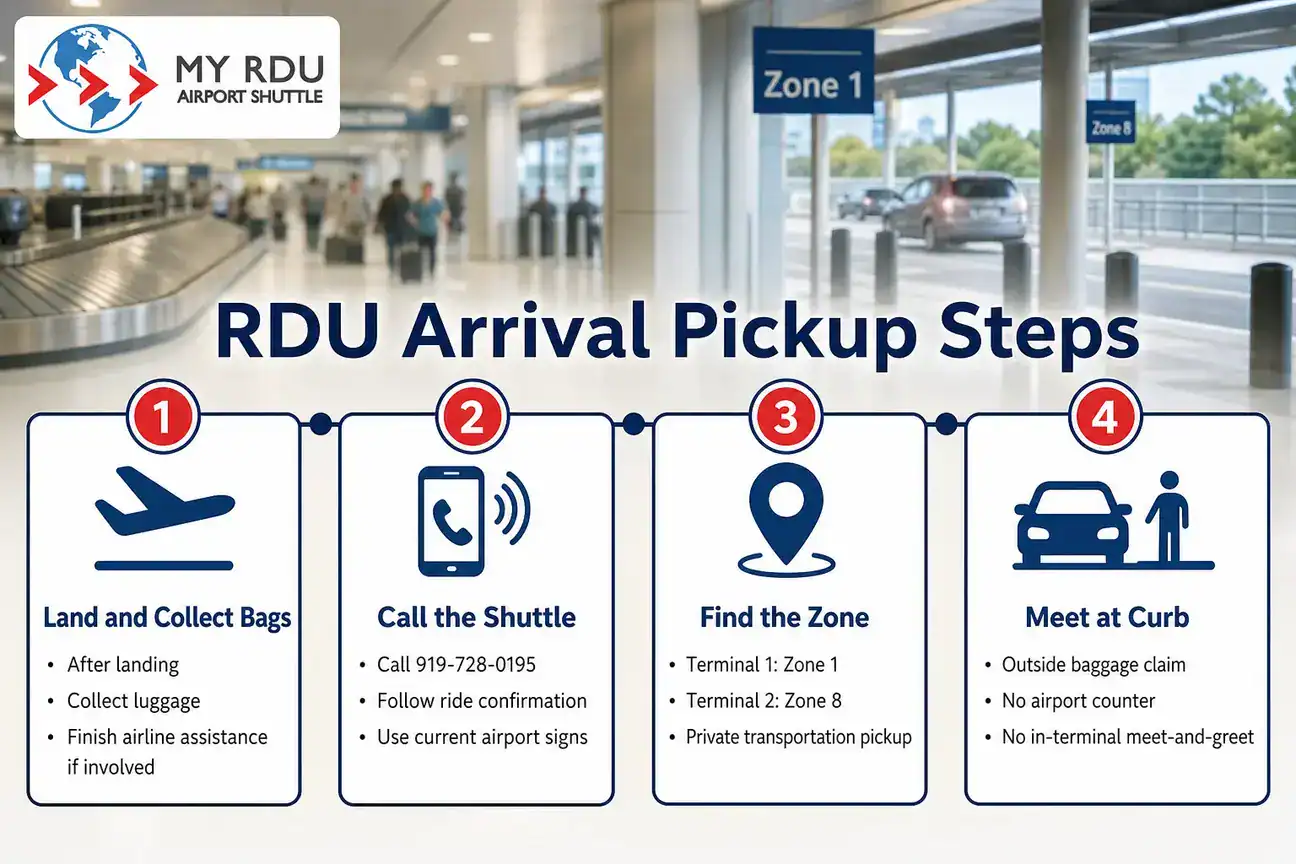
Arriving passengers should know that My RDU Airport Shuttle has no airport counter and does not provide in-terminal meet-and-greet service. After landing and collecting bags, call 919-728-0195 and follow the ride confirmation and current airport signs. If airline wheelchair assistance is involved, confirm where that assistance ends and how the traveler will proceed to the pickup area.
RDU’s transportation-services page lists private transportation pickup at the limo zones outside baggage claim: Terminal 1 uses Zone 1 and Terminal 2 uses Zone 8. Terminal 1 serves Southwest. Terminal 2 serves other airlines. Always follow current airport signage and the instructions in the reservation confirmation because airport procedures can change.
For airline-assisted arrivals, the important step is separating airport movement from vehicle pickup. The airline or airport assistance process may help the traveler reach baggage claim or another airport location, but that does not automatically notify the shuttle company. The traveler, caregiver, or agreed contact still needs to call My RDU Airport Shuttle after landing.
For hidden disabilities RDU arrivals, reduce decision-making in the moment. Write down the terminal, pickup zone, phone number, caregiver contact, and what to say when calling. A simple script can help: “I have landed at RDU, I have my bags, I am traveling with a folding walker, and I am going to the limo zone listed in my confirmation.”
For late-night arrivals, early-morning pickups, or trips involving older passengers, keep the phone charged and accessible. If the traveler is not comfortable calling, decide in advance whether a caregiver will make the call and how the traveler will know where to wait. The pickup and reservation FAQ is also a useful place to review general reservation and airport pickup information.
Arrival is also a good place to review ride expectations. The driver pickup process, the airline’s assistance endpoint, baggage collection, and caregiver communication should all be understood before the traveler reaches the commercial pickup zone.
If the flight changes, update the ride separately
Airline delays, cancellations, gate changes, and missed connections are airline matters first. Disability-related airline rights and responsibilities are separate from a private transportation reservation; the U.S. Department of Transportation publishes information for air travelers with disabilities. If a flight changes, contact the airline for flight assistance and contact My RDU Airport Shuttle separately with the new flight details.
Do not assume the original pickup plan automatically changes. My RDU Airport Shuttle should be called with the updated airline, flight number, arrival time, and phone contact. The company’s flight tracking, delay handling, cancellation terms, and change policies should not be assumed unless they are confirmed directly for the trip.
This matters even more for TSA Cares RDU requests and airline wheelchair arrangements. A changed flight may alter the timing, terminal, connection, or assistance handoff. Keep all confirmation numbers and phone contacts in one place so the traveler or caregiver can update the right organization quickly.
For travelers using hidden disabilities RDU resources, a changed flight can also change the stress level of the day. Keep instructions short, update the caregiver contact, and repeat the revised pickup steps in plain language.
Final confirmation checklist for caregivers and travelers
Use this checklist the day before travel, or earlier if the trip involves mobility equipment, a caregiver, multiple bags, a child seat, or a longer route to RDU. It is especially useful when one person books and another person travels.
- Airline wheelchair assistance or flight-related accommodation has been requested and confirmed.
- RDU Guest Experience contact information is saved if airport-specific help is needed.
- TSA Cares request is completed or 855-787-2227 is saved for screening-related help.
- My RDU Airport Shuttle reservation is confirmed with date, time, pickup address, destination, airline, and flight number.
- Passenger count, bags, oversized items, mobility equipment, and child-seat requests are recorded.
- Any wheelchair, scooter, walker, cane, or other device has been described clearly.
- Transfer ability and equipment dimensions have been discussed if relevant.
- The traveler and caregiver know who will call 919-728-0195 after landing.
- Terminal and commercial pickup zone instructions are saved.
- Any uncertain accommodation has been confirmed directly rather than assumed.
For a pre-booked ride, use book your ride online when the trip is not inside 24 hours. Travelers can call 919-728-0195 24/7 for booking questions or travel-day coordination; for rides inside 24 hours, call to check availability. Have the airline and flight number, travel date, pickup and drop-off addresses, passengers, bags, mobility equipment, child-seat needs, and travel-day phone number ready.
This final review should include wheelchair assistance RDU, TSA Cares RDU, hidden disabilities RDU notes, and accessible airport transportation details when they apply. Checking each item separately helps prevent one confirmation from being mistaken for another.
Closing reminder for a calmer trip
Traveling with accessibility needs is easier when no single organization is expected to handle every part of the trip. The airline handles flight-related assistance. RDU helps with airport-specific information and resources. TSA Cares supports checkpoint screening questions. My RDU Airport Shuttle coordinates the pre-booked ride and should receive the practical transportation details that affect timing, communication, equipment, luggage, and pickup.
The best RDU accessibility plan is specific, confirmed, and written down. Request help early, ask direct questions, and confirm anything that would affect whether the traveler can complete the trip comfortably. Airport procedures, airline rules and travel requirements change. Check your confirmation, your airline and RDU’s current information before you travel.
Frequently Asked Questions
Who should I contact for wheelchair assistance at RDU?
Contact the airline for flight-related wheelchair assistance, boarding, deplaning, and movement through the airport for that flight. Request it when booking or contact the airline before travel.
What is TSA Cares for?
TSA Cares supports travelers with disabilities, medical conditions, and other special circumstances during the security-screening process. It does not replace airline wheelchair service, private transportation, or baggage-claim-to-vehicle help.
How far in advance should I contact TSA Cares?
RDU says to contact TSA Cares at least 72 hours before the flight. If the flight is within 72 hours, TSA says to call TSA Cares at 855-787-2227.
Where does My RDU Airport Shuttle meet arriving passengers at RDU?
My RDU Airport Shuttle has no airport counter. After landing and collecting bags, passengers should call 919-728-0195 and follow their confirmation and current airport signs. RDU lists the commercial limo zones as Terminal 1, Zone 1, and Terminal 2, Zone 8.
Should I tell the shuttle company about a wheelchair or scooter?
Yes. Share the equipment type, approximate dimensions, whether it folds, whether the traveler can transfer into a vehicle seat, and how many bags are traveling before booking.
Does an accessibility request guarantee a wheelchair-accessible vehicle?
No. Do not assume an accessibility note or checkbox confirms a wheelchair-accessible vehicle, lifting, transferring, equipment handling, or physical assistance. Confirm the exact arrangement before travel.
Can a caregiver book the ride for someone else?
Yes. Provide the traveler’s name, caregiver contact, travel-day phone number, flight details, pickup address, bags, mobility equipment, and any needs that must be confirmed.
What should I do if the flight is delayed or changed?
Contact the airline for flight-related assistance and call My RDU Airport Shuttle separately with updated flight details. Do not assume the original pickup plan automatically changes.
Sources
Want to find more articles from RDU Airport Shuttle in Google Search? Add this site to your Preferred Sources.


